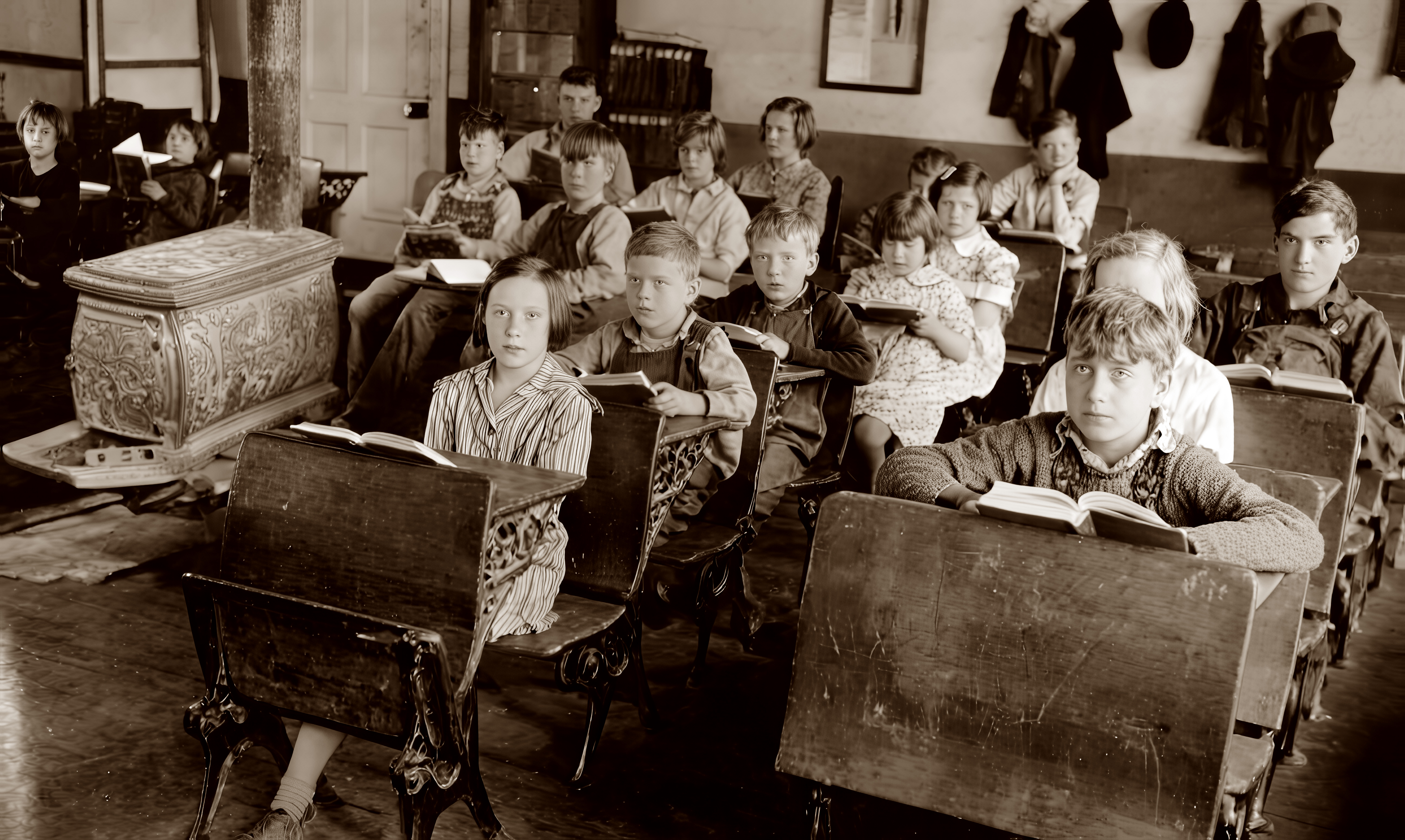

Inside the Youngs Creek Schoolhouse, 1923
There’s a stillness to the 1923 photograph of Youngs Creek School that feels almost audible—the kind of quiet that holds attention, not emptiness. Rows of wooden desks face forward. A potbelly stove anchors the room. Eight grades share the same space, the same teacher, the same expectations.
This was how much of America learned.
At their peak, there were roughly 200,000 one-room schoolhouses scattered across the rural United States. By 1930, 149,000 of the nation’s 238,000 elementary schools were one-room schools, and nearly half of all American children lived in rural areas. In the early 20th century, tens of millions of students—nearly half of all school-age children—were educated in schools like this.
They were simple, but they were everywhere. And because they were everywhere, they mattered.
In the Sunlight, c. 1946
Two decades later, the scene shifts outside. This is my mother’s class, around 1946—she stands in the back row, center. The war had just ended, but in Youngs Creek the one-room schoolhouse still defined daily life.

She attended grades 1 through 8 in that single room. She knew every student, every family. Learning wasn’t divided into systems—it was layered, shared, and constant. Younger students listened ahead; older students reinforced what they knew by helping others. Discipline and responsibility weren’t abstract—they were lived.
And it worked.
My mother would go on to graduate high school as salutatorian. Her younger sister, educated the same way in the same school, graduated as valedictorian. What began in one small classroom carried them confidently into a much larger world.
The Value of One Room
One-room schools made universal education possible in a rural nation. Before buses and consolidation, they placed learning within walking distance of farm families who otherwise might have gone without it.
They also created a distinct kind of education:
- Multi-age learning built reinforcement and independence
- Limited resources demanded focus and discipline
- Close community ties made education personal and accountable
Despite their simplicity, students from these schools often performed as well as—or better than—their urban peers when they advanced. They weren’t behind. In many cases, they were quietly ahead.
What Remains
Youngs Creek School was torn down in the 1980s, but not before I helped my parents rescue her desk from the wrecking ball. It sat in the kitchem alcove of our home.
The school is gone, like most one-room schools that once defined the American landscape. Only a handful remain in operation today.
But their legacy is enormous.
They educated millions. They built literacy across a rural nation. They proved that education doesn’t depend on size or complexity, but on expectation, attention, and community.
And sometimes, what remains of that legacy isn’t a building or a system—but something much smaller.
A desk.
A photograph.
A memory carried forward.
- National Center for Education Statistics (historical data on U.S. schools)
- Library of Congress (rural education archives)
- Smithsonian Institution (history of American education)
- Plains Humanities Alliance, University of Nebraska Education Week: One-room schoolhouse history feature VariQuest historical education
- Wikipedia: History of Education in the United States
Leave a Reply