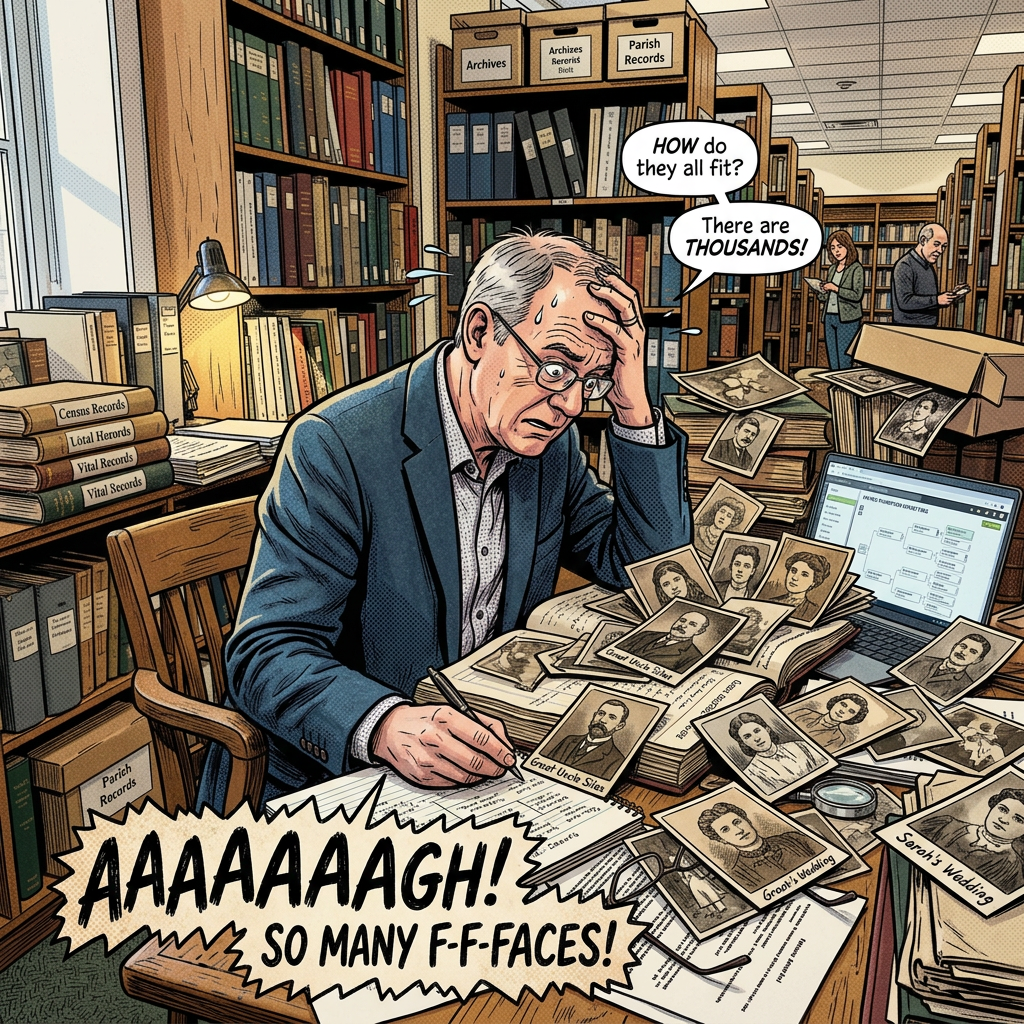
What began as “I really should organize these old family photographs” has somehow turned into a full-scale archival project.
At last count, I have scanned, catalogued, and sleeved about 150 photographs, newspaper clippings, programs, documents, and assorted family treasures dating from the late nineteenth century through the twentieth. Each item gets a catalog number and a digital copy, and many of the photographs have also been carefully restored.
The collection is beginning to divide itself naturally into family branches: The patriarchal branch of the Chapmans and Fenstermakers, and the matriarchal branch of the Youngs and Hancocks. Mercifully, a small number of people staring at me from photographs while refusing to identify themselves reside in the unidentified category.


The Chapmans are winning by sheer volume. Apparently nobody in that family ever encountered a camera without standing in front of it.


The real fun, though, has been discovering what was mixed into the boxes with the photographs. I’ve found school report cards, newspaper articles, programs, baby records, old watches, letters, and other little pieces of family history that nobody thought to throw away—which, for once, I’m extremely grateful for.


Some discoveries have answered questions. Others have created entirely new ones. I’ve learned about ancestors who were doctors, preachers, postmasters, teachers, soldiers, shopkeepers, and police officers. I’ve also learned that early twentieth-century Findlay, Ohio, was apparently a considerably more exciting place than anyone had warned me about.
And occasionally an unidentified photograph produces the genealogist’s favorite research notation:
“Who the hell are these people?”

What has surprised me most about this project is how much organizing the family history has changed the way I understand it. A family tree gives me names, dates, places, and relationships; the archive gives those things texture. A school report card, a newspaper clipping, a soldier’s photograph, or a handwritten note can reveal something about a person that no census record ever could.
Taken individually, many of these objects seem ordinary. Taken together, they begin to tell a much larger story—of families moving from place to place, raising children, building careers, going to war, celebrating milestones, enduring losses, and occasionally getting their names into the newspaper for reasons their descendants might have preferred they hadn’t.
The people in my family tree are becoming less like names in a database and more like people who actually lived.
And perhaps that’s ultimately what this archive is about: preserving enough of those small pieces that the generations who come after me can know them a little better, too.


For now, I’m almost finished with the scanning and cataloguing stage. The next step is to spread everything out, organize it by collection, and figure out the permanent physical arrangement.
It may look like a table covered with old photographs, plastic sleeves, newspaper clippings, envelopes, and miscellaneous objects.
I prefer “archive under active processing.”
It sounds much better.
And somewhere underneath all of that, I’m fairly certain there’s still a table.

Leave a Reply