Four portraits. Four lives. One carefully constructed vision of identity in the late 19th century.

By the 1880s and 1890s, the photography studio had become a fixture of everyday life in America. What had once been rare and expensive was now accessible—and deeply meaningful. Families marked milestones, asserted identity, and preserved legacy through carefully staged portraits like these.
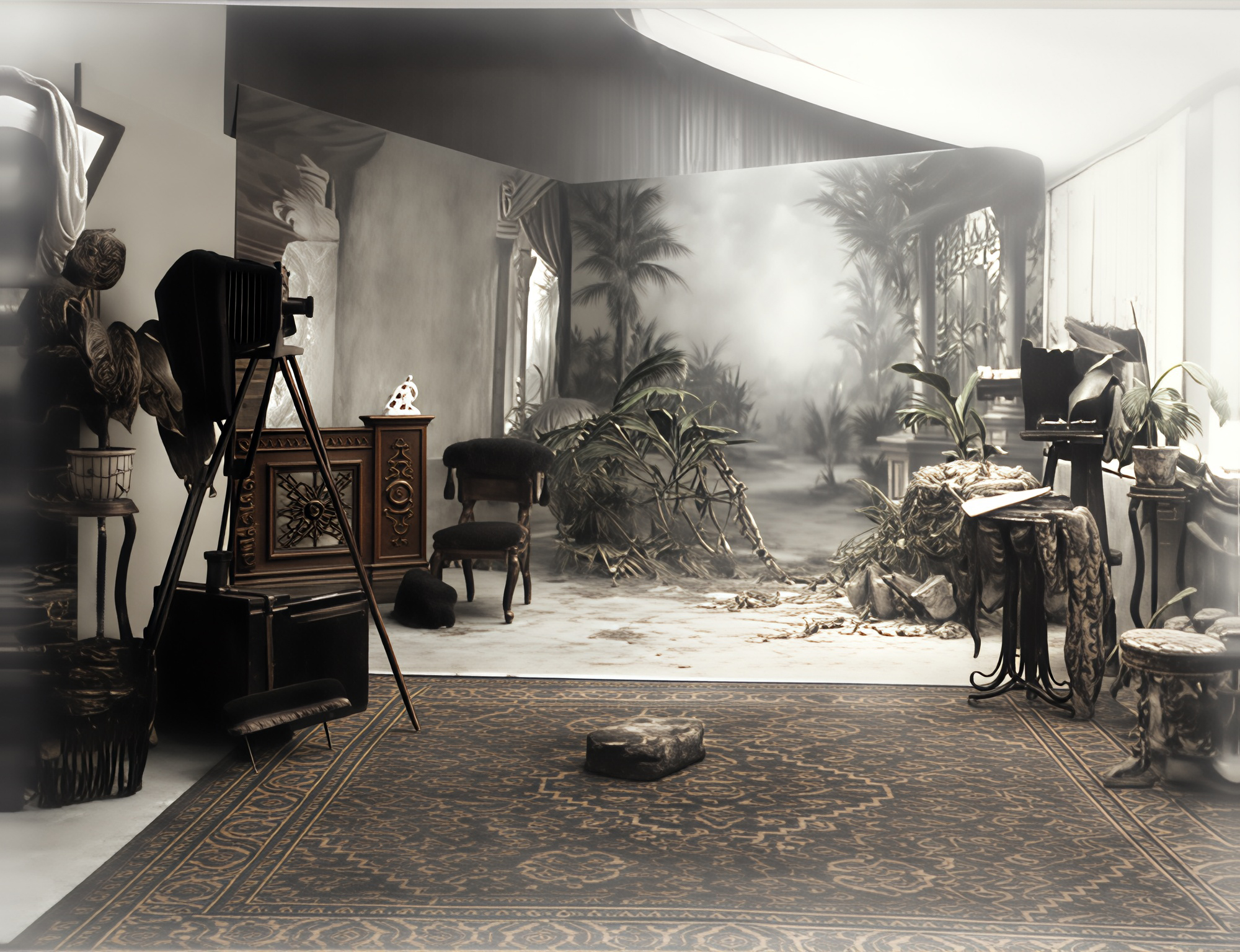
Stepping into a photography studio was an event. These were not casual images—they were deliberate acts of self-presentation. Every pose, garment, and backdrop reflected how individuals and families wished to be remembered.
These weren’t snapshots. They were decisions about legacy
Ida Davis Fenstermaker (1869–1936)

My 3rd great-grandmother’s portrait reflects classic Victorian studio composition. Props like carved furniture helped stabilize the sitter while conveying refinement.
Her fitted bodice and high collar place this image in the late 1880s–early 1890s, a transitional moment in women’s fashion.
The painted backdrop—common in studios—was not meant to deceive, but to elevate the sitter into an aspirational setting.
What’s most striking is her gaze—direct, steady, and unsmiling. Victorian portraits weren’t about spontaneity. They were about permanence.
Edward Elred Kellogg Chapman (1859–1932)

My great-grandfather’s portrait portrait reflects the popularity of cabinet cards, which became dominant after the 1870s as an affordable and widely distributed format.
The three-quarter pose and off-camera gaze were standard techniques used to create a sense of depth and character.
The sepia tone suggests an albumen print, the most common photographic process of the era.
The Victorian portrait evolved from display to introspection.
The Myers Brothers

This is where studio photography becomes almost architectural.
My great-granduncles are arranged with precision—seated figures anchoring the foreground, standing figures creating height and symmetry behind them. Every angle, every hand placement, is intentional.
Notice how physical contact connects them: a hand on a shoulder, an arm resting near another. These subtle touches communicate kinship without overt sentimentality.
And then there’s the facial hair. Each mustache is distinct, almost a personal signature, yet collectively they reinforce a shared identity. Their clothing—dark suits, consistent styling—adds to that unity.
This isn’t just a group portrait. It’s a visual statement of brotherhood.
William Denton and Family (1863–1946

My great-granduncle sits at the center, grounded and steady. His wife sits beside him, holding the baby—an unmistakable visual cue of maternal care. The children are arranged around them in layers, drawing your eye inward toward the family core.
Family portraits emphasized structure and roles. The seated parents form the core, while children are arranged to reinforce unity and hierarchy.
Children’s clothing—lace collars and formal dress—reflected Victorian ideals of innocence and discipline.
The infant’s white gown symbolized purity and continuity, a common visual motif in family portraiture.
In family portraits, composition becomes biography.
The Language of the Victorian Studio
- Controlled posing — Required by long exposures and cultural expectations
- Backdrops and props — Created aspirational environments
- Fashion as identity — Communicated status and respectability
- Composition — Structured visual storytelling
Why These Images Endure
Studio photography was intentional and performative. These portraits preserve not only likeness, but identity—how individuals wished to be seen by future generations.
- Batchen, Geoffrey. Each Wild Idea: Writing, Photography, History. MIT Press, 2001.
- Rosenblum, Naomi. A World History of Photography. Abbeville Press, 1984.
- Tortora, Phyllis G., and Keith Eubank. Survey of Historic Costume. Fairchild Books, 2010.
- Coe, Brian. The Birth of Photography. Ash & Grant, 1976.
- Library of Congress. “Cabinet Card Photographs.” Prints & Photographs Division.
- Newhall, Beaumont. The History of Photography. Museum of Modern Art, 1982.
- Getty Museum. “Albumen Print.” The J. Paul Getty Museum Collection.
- Darrah, William C. Cartes de Visite in Nineteenth Century Photography. 1981.
- Nickel, Douglas R. “History of Photography: The Victorian Era.”
- Higonnet, Anne. Pictures of Innocence: The History and Crisis of Ideal Childhood. Thames & Hudson, 1998.
Leave a Reply