
Simon Chapman and Mary (Brewer) Chapman lived in the tight-knit Puritan communities of Rowley and Ipswich in the Massachusetts Bay Colony. Married in 1666, they raised nine children and built a life grounded in faith, duty, and reputation.

Simon, a Freeman, held a respected place in society—entrusted with both civic responsibility and moral judgment.
In 1692, that responsibility would be tested.
Making a Stand for Elizabeth Howe

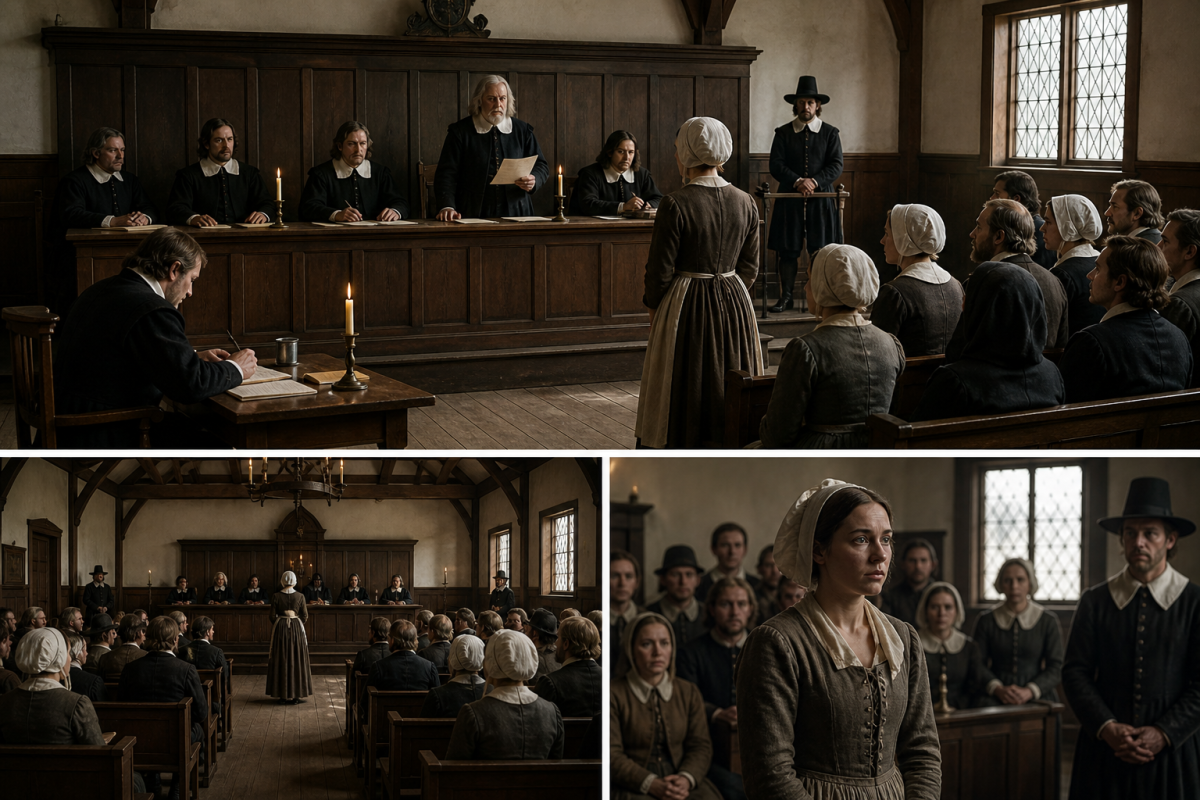
During the Salem Witch Trials, Simon and Mary testified on behalf of Elizabeth Howe, a woman accused of witchcraft. At a time when fear overwhelmed reason, they offered something rare—measured testimony grounded in lived experience.
Dated June 25, 1692, Simon’s statement reflects nearly a decade of knowing Elizabeth as a neighbor.
“I never saw any harm by her… she was faithful to her promises… she pitied those who accused her and prayed God would forgive them.”
— Testimony of Simon Chapman, June 25, 1692
Rather than condemning others, Elizabeth responded to suffering with humility, interpreting her trials as an opportunity for spiritual reflection. Simon described her as a woman deeply engaged in self-examination and sustained by faith.
Mary Chapman affirmed this account, adding her own voice to the testimony and signing alongside her husband.
The Original Testimony

Historical Context: The End of the Salem Trials
By the summer of 1692, accusations spread rapidly across Essex County. Courts relied on spectral evidence—claims difficult to prove.
By October, Governor William Phips dissolved the court. A new court required stronger evidence, and many were acquitted.
Executions ended in 1692. By early 1693, the crisis was over.
20
Executed
150+
Accused
1692–1693
Crisis Period
Faith Against Fear
By the summer of 1692, accusations of witchcraft had spread rapidly across Essex County. Courts increasingly relied on spectral evidence, and fear often outweighed reason.
In this environment, defending an accused neighbor required courage.
Simon’s testimony reveals the standards by which he judged character: humility, honesty, faith, and restraint. By those measures, he found Elizabeth How innocent.
A Tragic Outcome

Despite multiple testimonies in her defense, Elizabeth How was convicted and executed on July 19, 1692.
The voices of neighbors like Simon and Mary Chapman were not enough to stop the machinery of accusation.
Elizabeth is memorialized at the Salem Witch Trials Memorial in Salem, Massachusetts. Her name is inscribed on a granite bench maintained by Voices Against Injustice to honor victims.
A Personal Connection Across Centuries
When I first discovered that my ancestors were connected to the Salem Witch Trials, I expected the usual uneasy feeling that comes with that history. But the more I learned, the more something else took its place.
Pride.
My 7th great grandparents were not caught up in the accusations—they stood apart from them. At a time when fear spread quickly and silence was safer, they chose to speak from experience, to defend a neighbor’s character, and to ground their words in truth.
Their testimony did not change the outcome. Elizabeth How was still executed.
But it changes how I understand that moment in history—and how I understand them.
Across more than three centuries, their voices still carry. And now, in a small way, so does mine.
In a time of fear, they chose to speak from truth.
And though their words did not change the outcome,
they changed the record.
- Testimony of Simon Chapman, June 25, 1692
- Salem Witch Trials manuscript collection
- Massachusetts, Town and Vital Records, 1620-1988
- George Blodgette. Early Settlers of Rowley, Massachusetts : A Genealogical Record of the Families Who Settled in Rowley Before 1700.
Leave a Reply