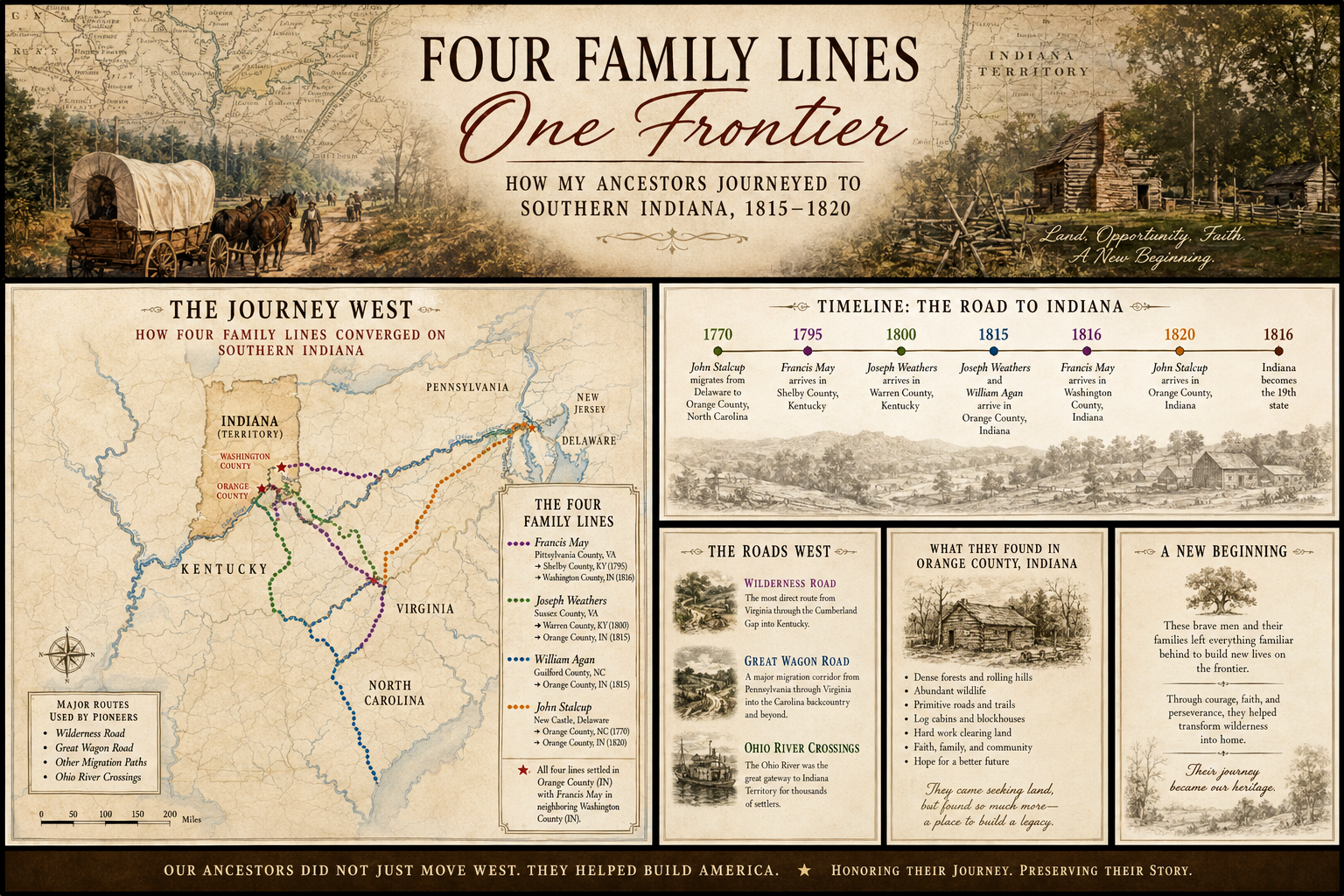

By the early 1800s, multiple branches of my family were on the move.
One came from Virginia by way of Kentucky. Another from North Carolina. Another had begun its journey in colonial Delaware before moving south and then west.
By 1820, all had converged in the same rugged corner of southern Indiana.
That was not coincidence.
These families were part of one of America’s great westward migrations—the movement of settlers into newly opened frontier lands following the Revolution and the formation of the Indiana Territory.
What began for me as scattered family records became something much larger: a story of migration, land, risk, and the building of an American frontier community.
My ancestors did not arrive after Indiana was settled.
They arrived while it was being settled
Why Southern Indiana?

Indiana’s earliest settlement began in the south, especially along the Ohio River corridor, where access from Kentucky made migration practical.
Southern Indiana became a magnet for early American settlers.
Newly available federal land, fertile uplands, river access, and the promise of ownership drew families westward.
My ancestors arrived at exactly that moment.
They were not joining an established community—they were helping create one.

Francis May, 4th Great Grandfather
Pittsylvania County, Virginia
Shelby County, Kentucky (1795)
Francis followed a classic frontier migration route from Virginia into Kentucky before crossing into southern Indiana.
Joseph Weathers, 5th Great Grandfather
Sussex County, Virginia
Warren County, Kentucky (1800)
Joseph arrived before Indiana achieved statehood, placing him among the earliest settlers in the region.
William Agan, 4th Great Grandfather
Guilford County, North Carolina
William represents the migration stream flowing out of North Carolina’s Piedmont toward the western frontier.
John Stalcup, 5th Great Grandfather
New Castle, Delaware
Orange County, North Carolina (1770)
John Stalcup’s family reflects a multigenerational westward movement stretching across fifty years.

These Journeys Didn’t Happen in Isolation
My ancestors traveled along some of the major migration corridors that shaped frontier America.
The Wilderness Road carried Virginians into Kentucky.
The Great Wagon Road funneled settlers south through the backcountry before turning westward.
The Ohio River became the great gateway into southern Indiana.
Go West, Young Man!

Land as the Motivation
Migration was not simply movement—it was acquisition.
Federal land records show these families claiming land in southern Indiana, transforming migration into permanent settlement.
Land ownership represented stability, opportunity, and independence in a way many eastern counties no longer could.


Federal land patents documenting ancestral settlement in southern Indiana
Life on the Frontier
Southern Indiana was no finished landscape. Dense hardwood forests covered the hills.
Roads were primitive or nonexistent. Cabins had to be built and fields cleared.
Disease, isolation, and uncertainty were constant realities.
Yet this frontier also offered possibility.

The Roads That Led to Me
Genealogy often begins as names and dates, but sometimes the records reveal something larger.
What I see in these migrations is not simply movement.
I see courage repeated across generations.
I see families choosing uncertainty over stagnation.
I see men and women building lives where none yet existed.
And I see how the roads they followed eventually led to me.
Their journey west became my beginning
- Bureau of Land Management General Land Office Records
- Orange County Indiana pioneer histories
- Indiana statehood historical records
- Federal land sale records migration route historical references
- Federal Census, 1820
Leave a Reply